The Choice to Abstain: Practical Steps to Opt Out of AI
/Tracking vs AI
When you look at the modern digital landscape, it is easy to confuse corporate tracking with artificial intelligence. They both capture your personal data and habits, but they use this information for different purposes. For decades, traditional tracking has acted like a silent digital observer, monitoring what you do online, and building a detailed file on your habits to sell to advertisers.
AI tools use your words, images, documents, or activity to train their “language models,” allowing them to be responsive to your needs in particular, and others’ needs in general. It also trains on the open web, digital books, academic papers, and computer code.
The products of this massive consumption of data falls into several general categories:
Smart Technology: assistants, navigation, facial recognition, coding
Productivity and Creative Tools: content generation, note taking, summaries, media creation, language translation
Healthcare and Medicine: drug discovery, medical imaging, predictive diagnostics
Finance and Business Operations: fraud detection, stock trading, customer support
Autonomous Systems and Logistics: self-driving vehicles, supply chain optimization
Understanding Your Options
As this technology permeates more and more of our society, it becomes more difficult to avoid. This article is aiming to give you options to avoid AI where you can.
When it comes to your digital privacy, not all tech companies are created equal, and they may treat each of their apps differently. With some apps, you can easily turn off AI. With others, the settings are buried and it is never clear if you have completely disabled AI. There are also applications that have no options at all – you need to either stop using that software or service, or allow AI to be present.
Navigating the Web
AI vs Traditional Search
When you look up something on a traditional search engine, the search relies entirely on computer algorithms, which are simply digital sorting engines that follow a strict set of rules to organize the data it has “scraped” from the public internet.
Traditional search brings those results to you and lets you decide what to do with them. AI search, instead of reading the web for you, consults the billions of pieces of information it has ingested, and presents you with the answer to your question. That answer may contain incorrect information and conclusions, but it may sound like a definitive statement of fact.
Alternate Web Browsers
The software applications (browsers) you use to view the internet often allow hidden corporate trackers to record what you do online. Switching to a privacy-first browser stops companies from monitoring your activity:
Brave, DuckDuckGo, and Vivaldi: Switch your web browser to one of these. They are free, easy to install and use, and automatically block tracking scripts and cookies. Don’t confuse search engines with browsers. DuckDuckGo also has a search engine.
More Extreme… Mullvad, Tor, and LibreWolf: Because these browsers block the scripts and tracking tokens that modern websites rely on to function, using them often results in a “broken” web experience. Brave, DuckDuckGo, and Vivaldi do not suffer from the same website-breaking problems because they intentionally prioritize convenience and daily usability over absolute, hardcore anonymity.
Ecosia: a free, privacy-focused alternative search engine that uses its advertising revenue to fund global tree-planting and climate action projects. Ecosia is kind of a hybrid. It lets you optionally use AI tools, but doesn’t let your searches be used for AI training. Every interaction is encrypted, and although a certain amount of tracking is done, it is anonymized after seven days and not sold to outside companies or advertisers.
Other browsers allow some tracking unless privacy settings and extensions are used, but some browsers block more tracking by default than others.
Traditional Search Engines
I am using the word traditional to mean that there is no AI involvement. Most mainstream search engines now force automated AI summaries above the other results, in addition to giving you regular website listings. Most browsers, like Safari or Chrome, will let you choose to use the search engine that you prefer.
DuckDuckGo (The Simple Safe Search): When using DuckDuckGo as your search engine, your search terms are kept completely private. However, the service now includes newer automated features. To keep your search entirely traditional, you must open the search engine’s settings menu and turn off their “AI Features” to ensure you don’t get AI results.
Startpage (Google-Quality Links Without Google Tracking): Startpage acts as an anonymous layer between your device and Google’s search algorithms. It submits your query to Google anonymously on your behalf, stripping away your IP address and tracking cookies before returning standard search results. AI is strictly optional.
Mojeek (The Genuinely Independent Index): Unlike DuckDuckGo and Startpage, which pull their results from Microsoft Bing or Google backend servers, Mojeek is a completely independent search engine. It uses its own custom web crawler to build an organic database of over nine billion pages.
Kagi (The Premium, Anti-Ad Power Option): If you don’t mind a subscription, Kagi costs $10 a month and is widely considered an excellent browser, perhaps the best. Because you pay for it, you get a clean search experience completely free of ads, tracking, and AI. It also includes a built-in filter that automatically removes machine-made images from your search results.
Google Search: Bypassing Google’s forced AI summaries is cumbersome. To get a normal list of website results, you will need to manually click the “Web” filter every single time you look something up.
Social Media Websites, Apps, and Forums
To have any real privacy or avoid AI training, you must accept a hard boundary: you cannot use mainstream social media websites or apps. If you want to avoid being monitored, complete abandonment is your only tool against companies that refuse to let you opt out.
Facebook and Instagram (Meta Companies): If you live in the United States, these platforms provide no real way to opt out of AI training or tracking. Meta is the primary offender for hidden tracking, building a deep, intimate profile on you by scanning your private habits, family and social connections, and even tracking what you do on other websites across the internet. Changing your settings on Facebook is pointless. To maintain your privacy and stop them from using your online habits to build AI systems, you have to stop using these social networks entirely and delete your accounts.
X / LinkedIn: You can opt out of generative AI training on both X (Twitter) and LinkedIn, but you cannot completely disable standard tracking. Both platforms opt you into AI model training by default, meaning you must manually change your privacy settings to stop it.
Reddit: Reddit operates as a massive open marketplace for your words. While they track less of your outside internet life than Facebook, Reddit is a major offender. They have multi-million-dollar deals to sell every comment and post to companies like Google and OpenAI to train their models. Your only tool to stop them from monetizing your comments is to delete your account.
Email Services
Google Gmail: Gmail uses message content to provide features such as categorization, smart replies, and writing suggestions. Google says Gmail content is not used to train Gemini AI models, but Gmail is still a cloud-based service with smart features that must be managed in settings. Turning all of these different features off is done in many different places, so it is never entirely clear what is still running.
It is hard to blindly trust Google's privacy promises when you look at their track record. They recently settled a massive $5 billion lawsuit after getting caught tracking people who were using Chrome’s private Incognito mode. They had to delete billions of data records to resolve the case, proving that “private” doesn’t always mean private with Google.
Microsoft Outlook: Microsoft automatically scans your emails to power their built-in AI tools and predictive writing features. Whether you subscribe to 365 or are using a free Outlook email account, your text is analyzed for both AI training and advertising profiles. To stop it, you must dig into your account privacy settings to manually turn off data collection and diagnostic tracking.
Apple Mail: If you use the default Mail app on a Mac, iPhone, or iPad, your privacy is significantly better. Apple does not scan the text of your emails to build advertising profiles or train global AI models. Furthermore, Apple offers a feature called “Protect Mail Activity” that hides your network location and blocks companies from tracking whether or not you opened an email. However, be aware that if you setup a Gmail or Outlook account in the Apple Mail app, Google and Microsoft can still track your data at their end.
Proton Mail: If you would like a completely private alternative, Proton Mail is what I recommend. It offers a free email tier that uses automatic end-to-end encryption. Like Apple, Proton does not have access to the content of your emails, so no monitoring, tracking, or AI can be engaged. See my article on Proton Mail.
Texting and Messaging
When you send a text message to family, friends, or associates, the safety of your private words relies entirely on how that message travels from phone to phone:
Standard SMS Texting: This is the old-fashioned texting that turns your bubbles green on an iPhone. SMS is not encrypted, so it is much less private than iMessage, Signal, or WhatsApp.
Apple iMessage: When you text with another iPhone user and the bubbles are blue, you are using iMessage. Like FaceTime, Apple builds iMessage with automatic, end-to-end encryption. Because the message is scrambled the moment you hit send, it is impossible for phone networks or Apple itself to read your texts or use your personal conversations to train AI.
Google Messages and RCS: Almost all modern Android phones support a texting system called RCS (Rich Communication Services), though it may not be on by default. While it does scramble messages between two people using the official Google app, group chats have a major flaw: if even one person in your group chat is using old-fashioned SMS texting, the encryption breaks for the entire group. None of the conversation is encrypted anymore, turning it back into clear text. Furthermore, even with RCS, your texting data remains linked directly to your Google account, meaning your habits, patterns, and shared links can still be used to build your broader profile within Google’s data network.
WhatsApp: Even though WhatsApp is owned by Facebook’s parent company, the app uses default end-to-end encryption for the text inside your chats. Facebook cannot read your words to train AI models. However, they still track who you message, what time you chat, and how often you use the app, to build their advertising profiles.
Storing Documents with Cloud Syncing Services
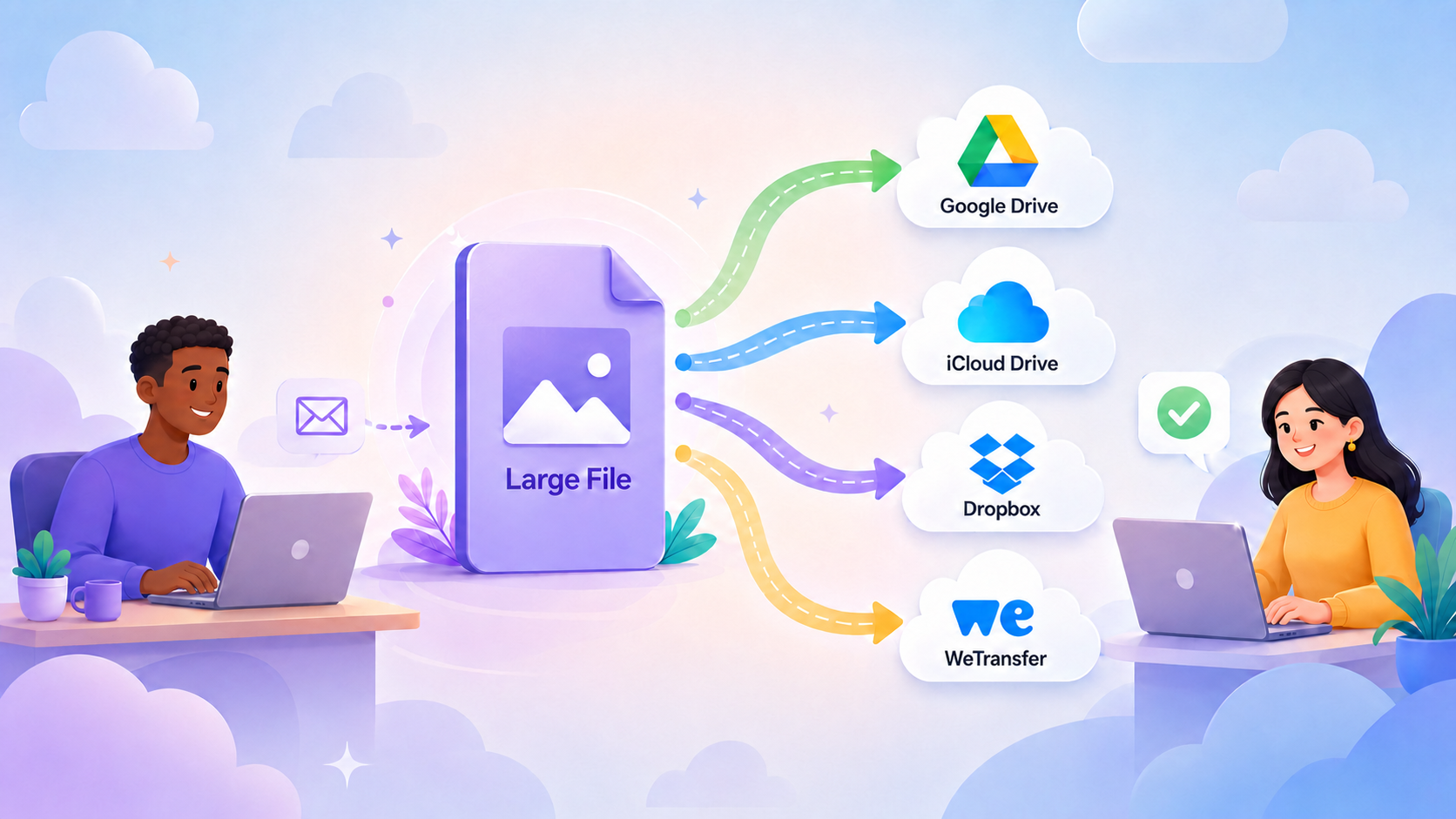
Cloud storage and file syncing platforms like iCloud Drive, Dropbox, Google Drive, and Microsoft OneDrive allow you to upload your computer files to a cloud and synchronize those files with other devices. They also let you maintain “cloud-only” files – effectively letting you delete the files from your computer.
Apple allows you to turn on Advanced Data Protection, making iCloud Drive private and encrypted, without AI or tracking.
OneDrive and Dropbox allow you turn off AI but not tracking. Google Drive makes it difficult to turn off AI through multiple settings. There is no way to stop their tracking.
Proton Drive offers a free tier that blocks tracking and AI, and includes end-to-end encryption.
Backing Up Online Files
Because these services allow you to maintain “cloud-only” files, your local backup methods like Time Machine, will not backup those files that are only in the cloud. See my article on Dropbox for a deeper look into this issue.
Using Applications to Create Your Documents
Documents and Spreadsheets
Productivity applications like word processors, spreadsheets, and accounting programs are increasingly connected to corporate servers.
Google Docs: Google Docs is a web-based word processor. When using it, Google integrates their Gemini AI assistant directly into your documents. While it is enabled by default, you can easily hide their automated writing tools right from the menu bar at the top of your document. However, standard Google account tracking for analytics, security, and product improvements remains active unless you adjust your broader account privacy settings.
Microsoft 365 (Word and Excel): Microsoft has hardcoded their AI assistant, Copilot, right into modern subscription versions of Word and Excel. If you create or edit documents while connected to the internet, your text interacts directly with their cloud systems. However, you may be able to use older, offline versions of Microsoft Office that do not connect to the cloud.
Apple Pages and Numbers: If you use a Mac, your built-in word processor (Pages) and spreadsheet app (Numbers) are fundamentally designed around local privacy. Your files stay local to your machine unless you explicitly choose to have them located in iCloud. Even if you use iCloud, turning on Advanced Data Protection keeps those files locked behind encryption keys that only you control.
LibreOffice (an MS Office alternative): To avoid Google Docs and Microsoft Office, you can switch to LibreOffice – a completely free, offline alternative to Microsoft Word and Excel.
LOCAL Accounting and Financial Software
There are various accounting programs that are not cloud-based, including GnuCash, Moneydance, and Quicken Classic. Quicken also makes an online accounting program called Quicken Simplifi.
Storage: These offline bookkeeping tools keep your tax ledgers, financial records, and business books saved strictly to your computer’s hardware.
AI Training: None, but Quicken Classic uses AI for local tasks unless you turn it off.
Tracking: Turned off completely, unless you use Quicken Classic. You can turn that off in their settings, as well.
Online Accounting Software
Most use mandatory AI and tracking. Zoho Books seems to be the exception with no tracking and AI that is sandboxed to avoid letting your data go outside the application environment. Sandboxing isolates apps into restricted, separated environments.
QuickBooks Online, Xero Accounting, and Quicken Simplifi
Storage: These are fully cloud-based applications. Your entire financial history, tax filings, client lists, and banking details live on their remote internet servers. Be sure you know how to back up your data to your local computer.
AI Training: Turned on by default and cannot be turned off. These programs’ automated internal systems read and analyze your financial data to automatically categorize your receipts, predict cash flow, and build automated reports.
Tracking: Turned on by default and cannot be turned off. These systems track your login locations, data entries, and system habits for security verification and feature performance.
Zoho Books
Storage: This is another fully cloud-based application.
AI Training: Turned on by default but sandboxed to the application’s environment.
Tracking: No tracking.
Video Meetings
If you use video meetings to stay in touch with family, friends, associates, or clubs, the privacy you get depends entirely on which company owns the software you are using:
Zoom and Microsoft Teams: Both platforms formally promise they do not use your actual conversation – such as your voice, video feed, or text chats – to train their core AI systems. However, both feature automated “AI Companions” that can write meeting summaries and transcribe your meetings. If the host of your meeting turns these tools on, others in the meeting cannot manually block them; your only choice is to accept the warning on your screen or leave the meeting. Furthermore, even with AI tools off, standard corporate monotoring still tracks details about your computer, your general location, and your app usage data.
Google Meet: Google Meet shares your video data across all of their other apps, and trying to stop it requires digging through complex account menus.
Apple FaceTime: If you want actual privacy, FaceTime is the gold standard. Apple uses default, end-to-end encryption for every FaceTime call. This means the data is completely scrambled before it leaves your device, making it physically impossible for Apple’s servers to read your video feed or listen to your voice to train AI systems.
Creative and Design Software
Affinity Suite (Made by Serif / Canva)
Storage: This software uses a completely local and sandboxed setup. Every project, layout, photo edit, or graphic illustration you make stays safely stored on your computer’s hardware. The software cannot dig into or read any other files on your machine without your permission.
AI Training: There is no AI training whatsoever. Your original artwork and personal designs are never sent to external servers or used to train corporate computer systems.
Tracking: Activity tracking is turned off completely. The company has no digital eyes inside your window and does not watch what you create or monitor how you use the tools.
Pixelmator Pro (Made by Apple)
Storage: Like Affinity, Pixelmator Pro is completely local and kept separate from the rest of your computer. Your pictures, digital paintings, and photo retouches are locked entirely to your physical machine.
AI Training: While the app features “smart” tools – like automatically removing a background or sharpening a blurry image – it uses your computer’s built-in processing chips only. It processes the adjustments offline and never sends your images out to cloud engines to do the computing.
Tracking: Tracking is non-existent. There is no remote monitoring of your editing habits or creative choices.
Creative Cloud Suite (Made by Adobe)
Storage: This is a hybrid, cloud-connected setup. While you can save files to your desktop, the software encourages you to save your projects to Adobe’s remote web storage.
AI Training: AI training is turned on by default. Adobe utilizes “content analysis” to study your designs and train its systems unless you manually log into your central Adobe account profile on the internet and opt out.
Tracking: User tracking is turned on by default. Adobe actively logs your software habits, feature usage, and workflow data. To stop this, you must manually hunt down the privacy toggles inside your account settings.
Music Creation and Audio Editing Software
Logic Pro / GarageBand (Made by Apple)
Storage: Audio recordings, musical compositions, and song arrangements remain strictly local and sandboxed on your personal device.
AI Training: The app features virtual session drummers and automated tempo tools, but these smart elements are completely offline. They calculate everything inside your computer’s built-in processing chips without uploading your recordings.
Tracking: Turned off completely. There is no background tracking or logging of what you choose to compose, sing, or record.
Reaper (Made by Cockos)
Storage: Reaper is an ultra-lightweight, traditional program. It operates entirely on your local disk and sandboxes your audio items so that they remain exclusively in your possession.
AI Training: None. The software contains absolutely no cloud-connected features or artificial intelligence components.
Tracking: Turned off completely. The developer collects no tracking data or usage habits from the software.
Audacity (Made by Muse Group)
Storage: Your raw vocal recordings and audio edits save straight to your storage drive, functioning as a traditional local application.
AI Training: None natively. The core program will never use your voice clips to train software. However, you can choose to install optional, cloud-based AI plugins from outside companies if you want them, meaning the choice is entirely yours.
Tracking: Limited tracking. The software collects basic computer specifications and technical error reports when the program crashes. You can block this data collection entirely by adjusting the privacy toggles in the program’s settings menu.
Video Creation and Editing Software
DaVinci Resolve (Made by Blackmagic Design)
Storage: Video projects and massive footage files sit entirely on your local storage drive. The app uses a secure, sandboxed approach that keeps your raw footage or film projects local to your workspace.
AI Training: The software includes advanced automated features like vocal isolation and smart masking, but it runs them using your own machine’s physical hardware. It never uploads your private video files to train a centralized corporate database.
Tracking: Tracking is completely turned off. There are no mandatory internet connection logs or background tracking tools following your editing timeline.
Final Cut Pro (Made by Apple)
Storage: All video libraries, audio tracks, and edited timelines are local and sandboxed, locked strictly to your Mac’s internal storage or an external drive you physically plug in.
AI Training: Smart features like automatic cropping or facial tracking are computed entirely offline using your Mac’s local processors, ensuring your private video data remains secure on your computer.
Tracking: Off completely. The software only collects anonymous diagnostic data if you choose to share crash reports with Apple, and this can be turned off globally in your Mac’s Privacy and Security settings.
Premiere Pro / After Effects (Made by Adobe)
Storage: This software relies on a cloud-connected hybrid model. It repeatedly suggests you to use cloud project backups and web-based collaboration panels to sync your timeline data and review proxies, while your raw video footage remains stored on local drives
AI Training: Turned on by default. Adobe uses your video compositions and asset data for model training. To keep your video projects from being ingested by their learning servers, you must explicitly opt out through your online Adobe web profile.
Tracking: Turned on by default. Background tools continuously track your editing clicks, timeline choices, and tool usage unless you manually disable the tracking under your online account privacy settings.
Software Opt-Outs
Some software companies give you specific menus to turn off AI training completely, though these settings only stop AI, and do not stop their normal corporate data collection.
Adobe (Photoshop / Acrobat): Open your account settings on the web and uncheck the specific box labeled “Content Analysis” to block their automated systems from scanning your cloud-stored projects to train machine learning models.
Slack: If you use this communication program for clubs or work, an administrator must email the company directly to request that team chats be excluded from global AI training models.
Operating Systems and Hardware Control
Computer Settings
Your Mac Computer: Open your Mac’s Privacy & Security settings and disable “Share Mac Analytics,” which stops details about how your computer is running from being sent to tech companies. Under the Apple Intelligence & Siri options, click on About Siri, Dictation & Privacy, turn off Siri’s ability to learn from your application usage habits locally. Turn on Advanced Data Protection in your iCloud settings on your Mac. This forces your backup files to be encrypted so that Apple cannot read them. It ensures Apple loses the decryption keys to your synced data, meaning your securely backed-up contacts, calendars, and notes cannot be read by anyone under any circumstances.
Your Windows PC: Gaining privacy on Windows is significantly harder because Microsoft does not offer a true “off” switch for device data tracking. Windows forces your computer to constantly report a baseline level of system habits back to their servers. Furthermore, their built-in assistant, Copilot, is tied directly into the machine, meaning tracking scripts remain active even if you hide the desktop icon. Microsoft also keeps the decryption keys to your cloud files on OneDrive, giving their automated systems full access to scan your documents.
Avoid Voice Assistants and Connected Devices
Voice-activated technology is built entirely around cloud tracking. Because these systems are designed to constantly listen, you cannot simply leave them active and try to ignore them.
Ditch the Smart Speakers: Replace smart speakers like Alexa or Google Home with traditional component audio systems (HiFi), or Bluetooth hardware, which is not cloud connected.
Skip Connected Appliances: Avoid buying internet-connected refrigerators or thermostats that package your daily household habits and send them to the cloud.
Mute Your Phone and Computer: Completely disable the voice assistants on your smartphone and Mac. Revoking microphone access and turning off “always-listening” mic settings is the only way to prevent your voice recordings from being saved and studied by tech companies.
Conclusion
It takes deliberate effort to avoid AI technology. If you do not want your data used to train large language models, it will require vigilance, as our digital landscape becomes embedded with AI features at every turn.